First Turkish summit as strategic partner; Athens tariff deal and Slovakia’s incoming 2027 presidency reshape Central Europe’s energy map
DUBROVNIK – The 11th Three Seas Initiative Summit, held in Dubrovnik on 28 – 29 April 2026, marked a turning point in Central Europe’s response to the loss of Russian gas transit through Ukraine. With Türkiye attending its first summit as a strategic partner – represented by Foreign Minister Hakan Fidan on behalf of President Recep Tayyip Erdoğan – and Slovakia preparing to take over the Initiative’s presidency in 2027, the south – north gas corridor moved from political vision to operational reality.
A reshaped energy map
The halt of Russian gas transit through Ukraine on 1 January 2025 cost Slovakia its key eastern entry point. The country’s response has been to anchor itself in a new south – north corridor linking LNG terminals and transit hubs in Türkiye, Greece and Croatia with markets in Central and Eastern Europe. Four pillars now define this architecture:
- TurkStream and Balkan Stream – currently the only active route for Russian pipeline gas into the EU, supplying Slovakia, Hungary and Serbia.
- TANAP/TAP – bringing Azerbaijani gas from the Caspian region via Türkiye, Greece and Albania to Italy and onward to Central Europe.
- Eastring – the Slovak bidirectional pipeline project (20 bcm, scalable to 40 bcm) connecting Slovakia with the Bulgarian–Turkish border.
- Vertical Gas Corridor – Türkiye/Greece – Bulgaria – Romania – Moldova/Ukraine, the operational backbone of the Three Seas Initiative.
Türkiye’s three roles for Slovakia
The political framework was set by the SR – TR strategic partnership signed on 20 January 2025 in Ankara by PM Robert Fico and President Erdoğan. In the corridor, Türkiye plays three interconnected roles:
- Alternative to the Ukrainian route. From February 2025, Slovakia began actually importing gas via TurkStream → Bulgaria → Hungary → Slovakia. Slovak SPP held intensive talks into 2025 and 2026 on raising capacity along this route.
- Gateway to Caspian gas. Azerbaijani gas reaches Europe via Türkiye’s TANAP network. Linking the Bulgarian–Turkish border to the Hungarian–Slovak interconnector at competitive prices is a key topic of the Vertical Corridor and forms part of the wider Dubrovnik agenda.
- LNG hedge. Turkish LNG terminals will serve as more than a backup when Greek terminals (Revithoussa, Alexandroupolis) are fully booked. EU-level discussions in 2026 explored solidarity mechanisms for prioritising Central European capacity in a crisis.
Türkiye at the table – first time as strategic partner
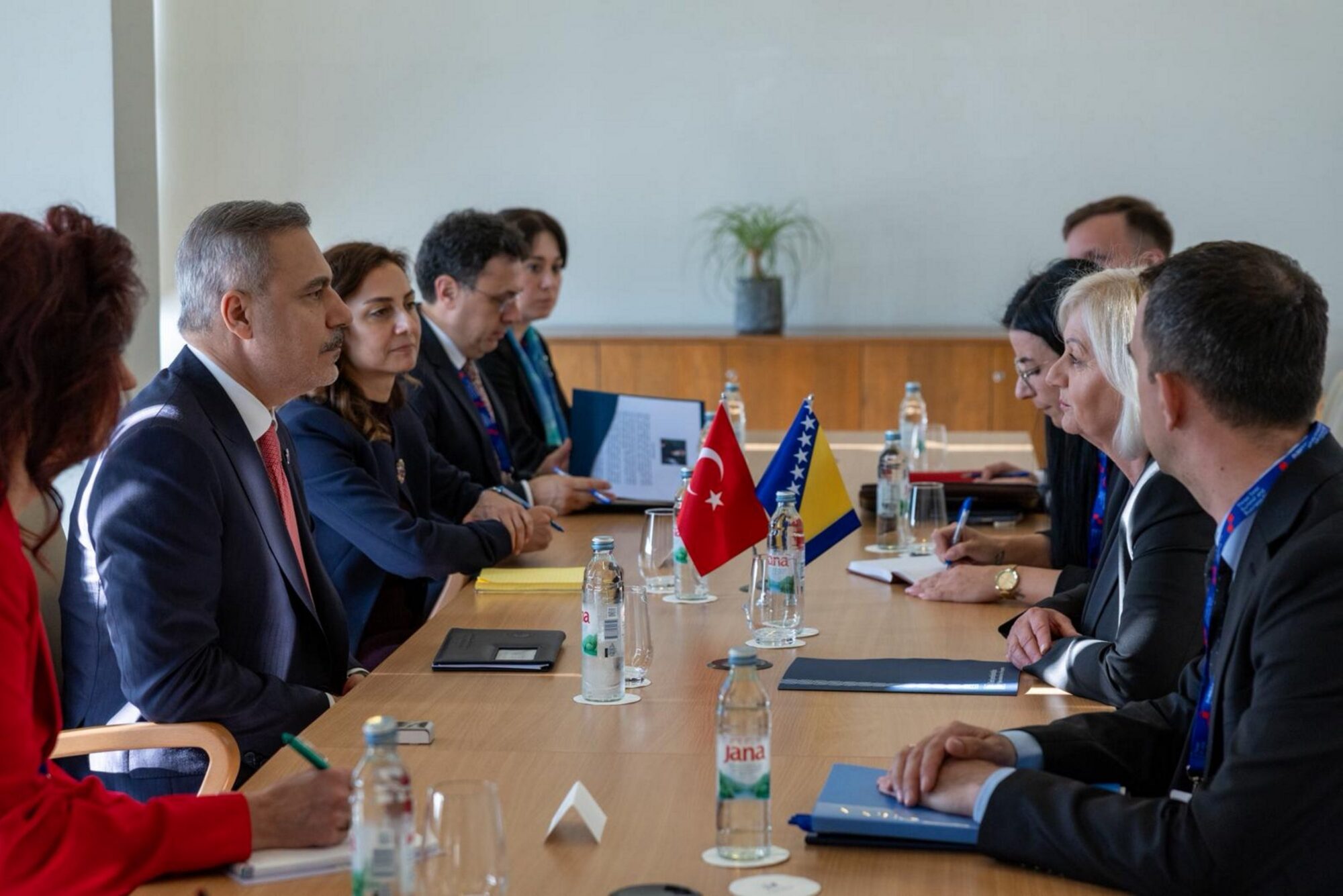
Foreign Minister Fidan addressed the summit on 28 April 2026, framing connectivity as a multidimensional ecosystem spanning transport, energy, digital systems, finance and governance. He signalled Türkiye’s readiness to deepen cooperation by leveraging its geostrategic position. On the sidelines, Fidan held bilateral meetings with Croatian Foreign Minister Gordan Grlić Radman and, on 29 April, with Chairwoman of the Council of Ministers of Bosnia and Herzegovina Borjana Kristo, alongside informal exchanges with several heads of state on regional energy security. Türkiye’s ministerial-level presence operationally connects the bilateral SR – TR partnership of January 2025 with the multilateral Three Seas framework, where Slovakia takes the presidency in 2027.
Athens tariff deal: making the corridor cheaper
On 27 March 2026 in Athens, the TSOs of Greece (DESFA), Bulgaria (Bulgartransgaz), Romania (Transgaz), Moldova (Vestmoldtransgaz), Ukraine (GTSOU) and the ICGB operator – together with the European Commission and ACER – approved a new tariff methodology for the Balkan section of the Vertical Corridor. For the first time, the regime introduces bundled capacity products (daily, monthly, quarterly and annual) effective from gas year 2026/2027. Shippers will see the route as a single stretch with a predictable price instead of country-by-country bookings. For Slovakia this means lower transaction costs, more predictable prices and higher utilisation of the Eustream network – essential for spreading fixed infrastructure costs across larger volumes. A politically sensitive point remains the certification of gas by origin. Türkiye blends Azerbaijani gas, LNG from various terminals and Russian gas from TurkStream. With the EU phase-out of Russian fossil fuel imports due by the end of 2027, Slovakia and Brussels must agree on how to certify gas leaving the Turkish system. Türkiye positions itself as a gas hub where origin becomes secondary. The dispute will be one of the key items on the agenda heading into 2027.
Slovakia’s gas security today rests on three physical pillars: the southern route via TurkStream and Hungary, the western route from Germany via Austria and the Czech Republic, and domestic storage – with Norwegian gas and LNG (US and Qatar). The political framework was set by the SR – TR strategic partnership of January 2025, the infrastructure framework by the Three Seas Initiative and the Vertical Corridor, and the commercial framework by the Athens agreement of 27 March 2026. The next tests are the extension of bundled products to Slovak entry points, the certification of gas origin from the Turkish system, and concrete progress on Eastring ahead of the Three Seas Summit 2027 in Slovakia.